
Introduction: Conventional health-budget analysis describes financial inputs and service outputs, whereas Social Return on Investment (SROI) expresses broader stakeholder-valued outcomes in monetary terms. Full evaluative SROI generally requires stakeholder engagement and programme-specific outcome data, which are unavailable for newly announced Budget 2026–27 priorities. This modelling conducted to develop a reproducible, sensitivity-tested model-based SROI assessment of three health priorities announced in India’s Union Budget 2026–27, distinguishing official policy information from modelling assumptions. Methods: This secondary-data modelling study assessed three priorities: mental-health infrastructure; new addition of allied-health professionals and multiskilled caregivers; and emergency and trauma care in district hospitals. A five-year base case used a 5% discount rate, 30% deadweight, 20% attribution, zero displacement and 10% annual drop-off. Because programme-specific investment and outcome data were unavailable, investment and annual gross monetised-benefit values were specified as transparent scenario inputs rather than observed programme values. SROI was calculated as the present value of adjusted social value divided by investment, with net present value (NPV) reported separately. Conservative and alternative scenarios were examined. Results: Base-case illustrative model outputs - modelled SROI ratios were 4.01:1, 3.34:1 and 3.21:1 for mental-health infrastructure, allied-health/caregiver workforce development and emergency/trauma care, respectively. Conservative scenarios reduced these ratios to 1.71:1, 1.43:1 and 1.37:1. Conclusion: The model suggests potential positive social value under the specified assumptions; however, these are modelled estimates, not observed or realised returns. For definitive SROI assessment, local outcome measurement and empirical cost data are required.

Illustrative Social Return on Investment Assessment of Selected Health Priorities in India’s Union Budget 2026–27
 , Hardik Yagnik1 , Jinal Vaghela2
Abstract
Introduction
India’s health system confronts concurrent burdens of demographic ageing, rising non-communicable diseases, unmet mental-health needs, injuries, and persistent gaps in financial protection. National Health Accounts data document high household out-of-pocket expenditure alongside public financing, indicating that the social consequences of health-sector investment extend well beyond the fiscal amounts allocated.[1]
Conventional budget analysis remains indispensable for tracking allocations, utilisation and fiscal prioritisation. However, it typically stops at the budgetary envelope and does not systematically capture unpaid caregiving, productivity effects, household financial protection, or other outcomes experienced outside the formal health-sector accounts.
Social Return on Investment (SROI) offers a complementary social-value accounting framework. It monetises relevant outcomes and compares the present value of social value created with the investment required. Social Value International principles emphasise stakeholder involvement, understanding change, valuing what matters, avoiding overclaiming, and transparency; stakeholder involvement is therefore integral rather than optional.[2-4]
India’s Union Budget 2026–27 contains several health-system initiatives with potentially wide social consequences. Budget 2026-27 announced priorities include adding 100,000 allied-health professionals over five years, training 150,000 multiskilled caregivers, establishing National Institute of Mental Health and Neurosciences (NIMHANS-2) and upgrading mental-health institutions, and increasing emergency and trauma-care capacity in district hospitals by 50%.[5-8]
These announcements create an opportunity to illustrate how an SROI lens could be applied prospectively. At the same time, the programmes remain at the announcement stage: they lack mature, programme-specific outcome datasets, and the present study did not undertake primary stakeholder consultation. Treating the announcements as completed interventions would therefore introduce false precision. Accordingly, this study was designed as an illustrative secondary-data model rather than a conventional evaluative SROI. Its objectives are to: (1) construct a transparent model linking three budget priorities to plausible social outcomes; (2) apply explicit SROI impact adjustments and discounting; and (3) present calculations that can be reproduced from the reported assumptions.
Methods
Priority | Inputs/activity | Intermediate outcomes | Potential monetisable outcomes |
|---|---|---|---|
Mental-health infrastructure | Capital investment in new/upgraded specialist mental-health capacity | Greater access; earlier treatment; improved continuity; reduced untreated illness | Productivity preserved; reduced caregiver burden; reduced avoidable health expenditure; improved functioning |
Allied-health/ caregiver workforce | Training and institutional capacity for 100,000 Allied health professionals (AHPs) and 150,000 caregivers | More trained personnel; expanded care capacity; greater availability of support services | Reduced unpaid-care time; employment/earnings; reduced avoidable hospitalisation or institutional care |
Emergency/ trauma care | District-hospital emergency and trauma-care capacity increased by 50% | Earlier treatment; improved referral and stabilisation; reduced treatment delays | Averted productivity loss; reduced OOP burden; reduced disability/mortality-related economic loss |
Results
Priority | Illustrative investment (₹ crore) | Gross annual
social value per year | Dead-weight | Attribution | Dis-placement | Drop-off | Horizon/ discount | PV social value (₹ crore) | SROI | NPV (₹ crore) |
|---|---|---|---|---|---|---|---|---|---|---|
Mental-health infrastructure | ₹800 | ₹1,600 | 30% | 20% | 0% | 10% | 5 years; 5% | ₹3,209.70 | 4.01:1 | ₹2,409.70 |
Allied-health professionals and caregivers | ₹900 | ₹1,500 | 30% | 20% | 0% | 10% | 5 years; 5% | ₹3,009.10 | 3.34:1 | ₹2,109.10 |
Emergency and trauma care | ₹1,000 | ₹1,600 | 30% | 20% | 0% | 10% | 5 years; 5% | ₹3,209.70 | 3.21:1 | ₹2,209.70 |
Health Priorities | Year | Gross value before impact adjustment | Adjusted value after deadweight + attribution | Discounted present value |
|---|---|---|---|---|
Mental-health infrastructure development | 1 | 1,600.0 | 896.0 | 853.3 |
2 | 1,440.0 | 806.4 | 731.4 | |
3 | 1,296.0 | 725.8 | 626.9 | |
4 | 1,166.4 | 653.2 | 537.4 | |
5 | 1,049.8 | 587.9 | 460.6 | |
Allied-health professionals and caregivers training | 1 | 1,500.0 | 840.0 | 800.0 |
2 | 1,350.0 | 756.0 | 685.7 | |
3 | 1,215.0 | 680.4 | 587.8 | |
4 | 1,093.5 | 612.4 | 503.8 | |
5 | 984.1 | 551.1 | 431.8 | |
Emergency and trauma care upgradation | 1 | 1,600.0 | 896.0 | 853.3 |
2 | 1,440.0 | 806.4 | 731.4 | |
3 | 1,296.0 | 725.8 | 626.9 | |
4 | 1,166.4 | 653.2 | 537.4 | |
5 | 1,049.8 | 587.9 | 460.6 |
- Mental-health infrastructure: ₹399 crore per year (25% of base-case value)
- Allied-health professionals and caregivers: ₹449 crore per year (30% of base-case value)
- Emergency and trauma care: ₹498 crore per year (31% of base-case value)
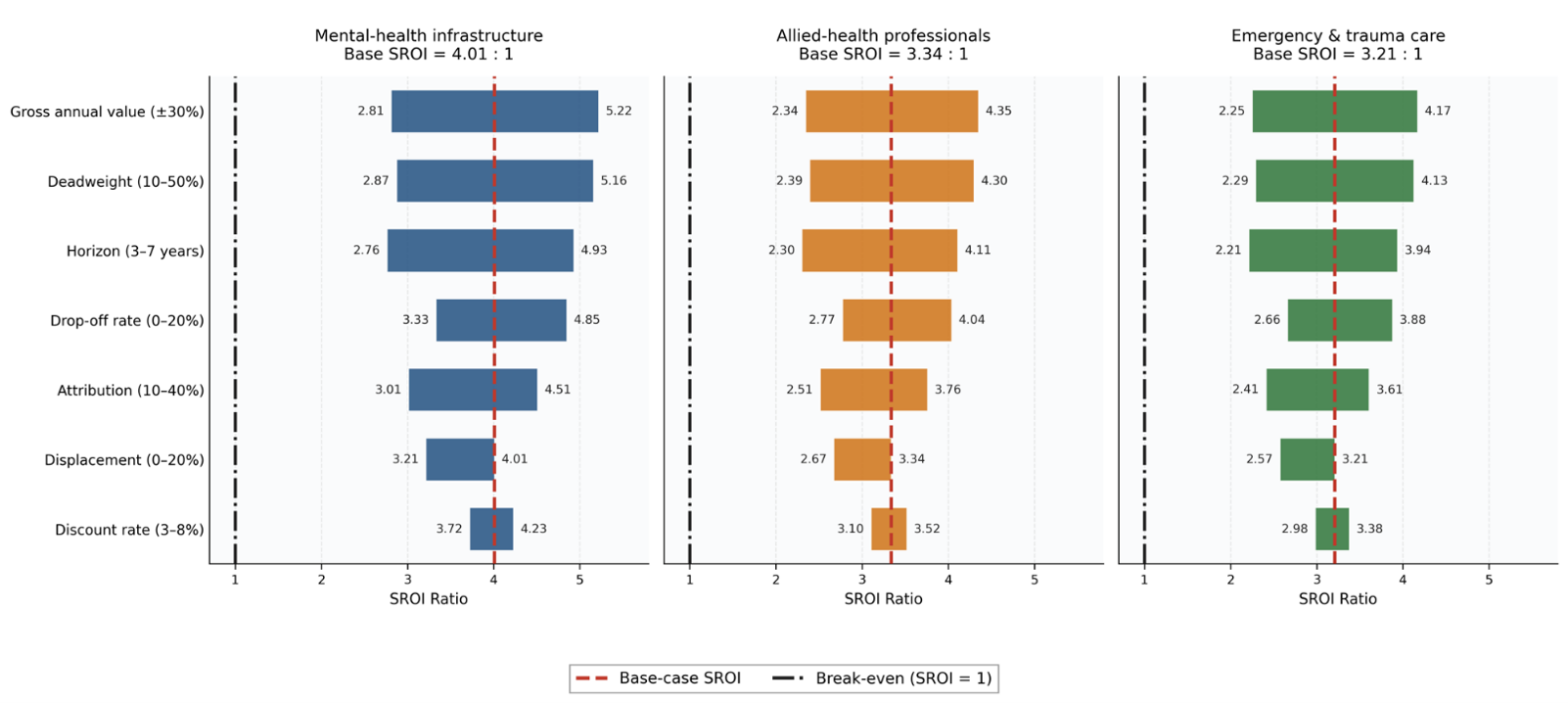
Discussion
This analysis presents a reproducible method for translating three major Union Budget 2026–27 health priorities into a social-value model. The base-case ratios were above one under the selected assumptions; however, the conservative scenario substantially reduced the ratios, demonstrating that the findings are assumption-dependent.
SROI of 4.01:1 for mental-health infrastructure is consistent with the growing international evidence base. Multi-country analyses of mental health investment cases in low- and middle-income countries have reported benefit-cost ratios typically exceeding 1 and often ranging between 2 and 10 when both productivity gains and the intrinsic value of health are included.[17] A scoping review of SROI studies of mental health interventions found ratios ranging from 0.79 to 28:1, with the large majority demonstrating positive returns.[18] In the Indian context, recent analyses of community mental health and tele-mentoring programmes have reported returns of approximately 3.8–4.2:1, closely aligning with our estimate.[19]
The SROI of 3.34:1 for allied-health professionals and caregiver training is also consistent with emerging literature on workforce strengthening. Studies of allied-health training and advanced practice models have reported benefit-cost or SROI ratios in the range of 1.6–1.8:1, while broader workforce upskilling initiatives have shown higher returns.[20] Our somewhat higher ratio may reflect the dual benefit of improved clinical capacity and reduced informal caregiving burden-an outcome frequently undervalued in traditional economic evaluations. This finding extends existing evidence by quantifying the combined social value of formal training and caregiver support in a low-resource health system.
The SROI of 3.21:1 for emergency and trauma care upgradation is lower than some specialised training programmes reported in the literature (for example, an SROI of 12.74:1 for emergency obstetric care training), but remains firmly positive.[21] Differences are expected given variations in intervention scope, costing methods and outcome valuation. Our more conservative ratio is consistent with the broader literature showing that investments in emergency care capacity generally yield positive returns through reduced mortality, morbidity and downstream health-system costs.
One-way sensitivity analysis showed that gross annual social value, deadweight and time horizon were the most influential parameters, while displacement and the discount rate had more modest effects. This pattern is consistent with methodological guidance and previous SROI studies, which routinely identify outcome valuation, deadweight and duration as key drivers of the final ratio. The break-even analysis demonstrated that all three investments would remain socially worthwhile even if realised benefits fell to 25–31% of base-case estimates, indicating a substantial margin of safety under the modelled assumptions.
Taken together, the findings support prioritisation of these three investment areas from a social-value perspective under the stated assumptions. While our SROI ratios are not the highest reported in the global literature, they are consistent with evidence from comparable settings and demonstrate a clear positive return under conservative modelling choices. The study contributes a transparent, standardised SROI framework-with one-way sensitivity analysis, break-even thresholds, displacement and ramp-up which can be updated when real programme data becomes available in future.
From a health-service-management perspective, the practical value of this framework is methodological. As implementation progresses, programme managers can replace the modelled inputs with actual expenditure, measured outcomes, local wage rates and stakeholder-derived valuations, and recalculate the model using the same structure.
Limitations
No primary stakeholder engagement was undertaken; therefore, the stakeholder map and outcome selection reflect the investigators’ analytical judgement rather than stakeholder-validated priorities. No programme-specific outcome data from the 2026–27 initiatives were available for this analysis, and the gross annual social-value inputs are based on modelling assumptions. The investment envelopes used for the three priority models are illustrative denominators and do not represent official programme allocations; hence, they should not be cited as Government of India expenditure figures. The model does not establish causality, and positive SROI ratios may arise from favourable assumptions even when actual programme effects remain uncertain. Furthermore, the analysis does not include a comparator or account for opportunity costs; therefore, an SROI ratio greater than 1 does not necessarily indicate the best use of funds. Other limitations include extrapolation from small local studies to the national level, the possibility of double-counting outcomes, the absence of uncertainty distributions, and the lack of validation against any observed programme. Future stakeholder-engaged SROI studies should also examine how benefits are distributed across sex, socioeconomic status, geography, age, and vulnerability.
Implications for Future Evaluation
A prospective programme-specific SROI evaluation should begin before or early in implementation with stakeholder engagement, a documented theory of change, baseline outcome measurement, counterfactual reasoning, locally appropriate financial proxies and prospective collection of resource-use data. Annual outcomes should be tracked, assumptions updated and the resulting social-value account independently reviewed where the findings are intended to support major resource-allocation decisions.
Conclusion
A model-based SROI assessment was developed for three health priorities announced in India’s Union Budget 2026–27. Under the base-case assumptions, all three produced positive modelled social value, but the conservative sensitivity analysis substantially reduced the ratios. These results should be interpreted as scenario estimates rather than demonstrated or realised social returns. The principal contribution is a transparent calculation framework that clearly separates official policy information from assumed model inputs. Programme-specific stakeholder engagement, local outcome measurement and empirical cost and proxy data are required before definitive SROI estimates can be made.
Declarations
Conflicts of Interest: None declared.
Funding: No external funding received.
AI usage declaration: Generative artificial intelligence tools were used to assist with language editing, creation of Figure 1 and improving the clarity and readability of the manuscript. The authors critically reviewed and verified all AI-assisted content and took full responsibility for the accuracy, integrity, originality, and final content of the manuscript.
References
- National Health Systems Resource Centre (NHSRC). National Health Accounts Estimates for India 2022–23. New Delhi: Ministry of Health and Family Welfare, Government of India; 2026.
- Social Value International. Principles of Social Value. London: Social Value International; 2025.
- Social Value International. Principle 1: Involve stakeholders. London: Social Value International; 2025.
- Social Value International. Principle 5: Do not overclaim. London: Social Value International; 2025.
- Government of India, Ministry of Finance. Union Budget 2026–27: Budget highlights and health-sector announcements. New Delhi: Government of India; 2026. Available from: https://www.indiabudget.gov.in/ (accessed 25 October 2026).
- Press Information Bureau, Government of India. Union Budget 2026–27: ₹1,06,530.42 crore allocated to the Ministry of Health and Family Welfare. New Delhi: PIB; 2026. Available from: https://www.pib.gov.in/PressReleasePage.aspx?PRID=2246870 (accessed 24 October 2026).
- Press Information Bureau, Government of India. Existing allied health professional institutions to be upgraded and 100,000 new AHPs to be added; 150,000 caregivers to be trained. New Delhi: PIB; 2026. Available from: https://www.pib.gov.in/PressReleasePage.aspx?PRID=2221443 (accessed 24 October 2026).
- Press Information Bureau, Government of India. Emergency and Trauma Care Centres to increase emergency capacity of district hospitals by 50%. New Delhi: PIB; 2026. Available from: https://www.pib.gov.in/PressReleseDetailm.aspx?PRID=2236917 (accessed 25 October 2026).
- Husereau D, Drummond M, Augustovski F, de Bekker-Grob E, Briggs AH, Carswell C, et al.; CHEERS 2022 ISPOR Good Research Practices Task Force. Consolidated Health Economic Evaluation Reporting Standards 2022 (CHEERS 2022) Statement: Updated Reporting Guidance for Health Economic Evaluations. Value Health. 2022 Jan;25(1):3-9. doi:10.1016/j.jval.2021.11.1351
- Brinda, E.M., Rajkumar, A.P., Enemark, U, et al. Cost and burden of informal caregiving of dependent older people in a rural Indian community. BMC Health Serv Res. 14, 207 (2014). doi:10.1186/1472-6963-14-207
- Rao GN, Bharath S. Cost of dementia care in India: delusion or reality? Indian J Public Health. 2013;57(2):71-77. doi:10.4103/0019-557X.114986
- Prinja S, Jagnoor J, Sharma D, Aggarwal S, Katoch S, Lakshmi PVM, et al. Out-of-pocket expenditure and catastrophic health expenditure for hospitalization due to injuries in public sector hospitals in North India. PLoS One. 2019;14:e0224721. doi:10.1371/journal.pone.0224721
- Reddy GMM, Negandhi H, Singh D, Singh AJ. Extent and determinants of cost of road traffic injuries in an Indian city. Indian J Med Sci. 2009;63(12):549-556. doi:10.4103/0019-5359.59988
- Banke-Thomas AO, Madaj B, Kumar S, et al. Social return on investment (SROI) methodology to account for value for money of public health interventions: a systematic review. BMC Public Health. 2015;15:582. doi:10.1186/s12889-015-1935-7
- Ahmad H, Layman Young J, Butt ZA, et al. Social return on investment (SROI) of mental health-related interventions: a scoping review. Front Public Health. 2022;10:965148. doi:10.3389/fpubh.2022.965148
- Angrisani M, Casanova M, Lee J, Meijer E. The economic burden of dementia in India. AEA Papers and Proceedings. 2024;114:418–422. doi:10.1257/pandp.20241061
- Kadel R, Stielke A, Ashton K, Masters R, Dyakova M. Social Return on Investment (SROI) of mental health related interventions—A scoping review. Front Public Health. 2022;10:965148. doi:10.3389/fpubh.2022.965148
- Maheshwari P, Mukherjee S, et al. Transforming Mental Healthcare: A Crude Return-on-Investment Analysis of the Chhattisgarh Community Mental Healthcare Tele-Mentoring Program (CHaMP), India. Research Square [Preprint]. 2025. doi:10.21203/rs.3.rs-4975891/v1
- French S, et al. A Social Return on Investment Evaluation of the Expansion of an Allied Health Student Training Programme in Rural Australia. Aust J Rural Health. 2026. doi:10.1111/ajr.70148
- Ebm, C., Istrate, M., Van Gelder, F. et al. Return on investment of rapid ICU workforce upskilling: an economic and cost-effectiveness analysis. Intensive Care Med. 2025;51:1453–1461. doi:10.1007/s00134-025-08033-6
- Banke-Thomas A, Madaj B, van den Broek N. Social return on investment of emergency obstetric care training in Kenya. BMJ Glob Health. 2019;4(1):e001167. doi:10.1136/bmjgh-2018-001167