Introduction: Direct Observation of Procedural Skills (DOPS) is a workplace-based assessment method combining direct observation with structured formative feedback. This study assessed changes in procedural assessment scores, supervision requirements, and perceptions following DOPS implementation in postgraduate anaesthesiology training. Methods: A single-centre, uncontrolled pre–post intervention study with an embedded qualitative component was conducted from May to August 2025 at a Medical College, of Gujarat, India. Eight postgraduate anaesthesia residents and ten faculty members participated. Each resident underwent at least two DOPS encounters involving a selected procedure, with structured feedback provided after assessment. Pre- and post-feedback scores, supervision requirements, and participant perceptions were evaluated using structured assessment tools, questionnaires, and focus group discussions. Paired observations were analysed using a paired t-test. Results: The mean DOPS score increased from 3.75±0.83 to 6.25±0.83, with a mean paired improvement of 2.50±0.53 points (95%CI: 2.05, 2.95; p< .001). The proportion requiring continuous assessor presence in the operating theatre decreased from 50% to 0%, while four residents (50%) were categorized as performing independently at reassessment. The overall resident perception score was 4.19/5. Structured feedback and faculty–resident communication were perceived positively, whereas time constraints and assessor variability were reported as challenges. Conclusion: DOPS implementation was associated with improved procedural assessment scores and reduced supervision requirements among participating residents. Larger controlled studies with standardized assessment procedures and longer follow-up are needed to determine effectiveness and sustainability.

Direct Observation of Procedural Skills in Postgraduate Anaesthesia Training: Changes in Procedural Performance, Supervision Requirements, and Resident–Faculty Perceptions
 , Nishita Jethva2 , Anandu M3 , Punit Patel4*
- 1 Professor, Department of Anaesthesia, GMERS Medical College, Himmatnagar, India
- 2 Assistant Professor, Department of Anatomy, GMERS Medical College, Sola, Ahmedabad, India
- 3 Senior Resident, Department of Anaesthesia, GMERS Medical College, Himmatnagar, India
- 4 Professor, Department of Community Medicine, Banas Medical College and Research Institute, Palanpur, India

Abstract
Introduction
Postgraduate training in anaesthesiology requires progressive development of clinical and procedural competence. In addition to theoretical knowledge, residents must acquire skills in patient assessment, procedural preparation and execution, communication, decision-making, patient safety, recognition of complications, and appropriate help-seeking. These competencies are particularly important in anaesthesiology, where procedures are often performed in dynamic clinical settings and directly influence patient outcomes.[1]
Assessment is an essential component of postgraduate training, as it guides learning, identifies areas requiring improvement, and supports progression toward independent clinical practice. Conventional assessment methods often emphasize knowledge and performance in examination settings and may provide limited opportunities to directly evaluate procedural competence during routine patient care.[2,3] The shift toward competency-based medical education has therefore increased the importance of workplace-based assessment (WPBA), which evaluates trainees in authentic clinical settings while facilitating learning through structured feedback.[4,5]
Direct Observation of Procedural Skills (DOPS) is a structured WPBA method in which an assessor directly observes a trainee performing a procedure, evaluates predefined components using a standardized tool, and provides timely formative feedback.[6] This process helps identify strengths and areas requiring improvement, while repeated DOPS encounters may facilitate progressive development of procedural competence and independence.
DOPS is particularly relevant to anaesthesiology, where residents routinely perform procedures such as endotracheal intubation, spinal anaesthesia, airway management, and vascular access. Previous studies have reported favourable perceptions of DOPS and suggested that repeated direct observation with feedback can improve procedural performance.[7] However, its implementation may be influenced by time constraints, faculty participation, assessor variability, and trainee acceptance.
Despite increasing emphasis on competency-based postgraduate education, procedural competence is often assessed through routine clinical supervision without standardized documentation or structured feedback. At current medical college where the study has been conducted, DOPS had not been routinely incorporated into postgraduate anaesthesia training, providing an opportunity to evaluate its usefulness as a structured formative assessment strategy.
Therefore, the present study aimed to introduce DOPS as a workplace-based formative assessment tool among anaesthesia residents and evaluate its usefulness by assessing changes in procedural performance and supervision requirements, along with resident and faculty perceptions regarding its implementation.
Methods
Results
Resident | Pre-feedback score | Post-feedback score | Change |
|---|---|---|---|
JR1 | 3 | 5 | 2 |
JR2 | 3 | 6 | 3 |
JR3 | 3 | 5 | 2 |
JR4 | 3 | 6 | 3 |
JR5 | 5 | 7 | 2 |
JR6 | 5 | 7 | 2 |
JR7 | 4 | 7 | 3 |
JR8 | 4 | 7 | 3 |
Mean±SD | 3.75±0.83 | 6.25±0.83 | 2.50±0.53 |
Major themes | Subthemes | Participant quotations |
|---|---|---|
Enhanced procedural confidence | Increased confidence; identification of skill gaps; improvement following feedback | “After receiving feedback, I became more confident in performing the procedure and understood which steps needed improvement.” — Resident (R1) |
Improved faculty–resident communication | Constructive feedback; improved interaction; clarification of learning needs | “DOPS provided an opportunity to discuss procedural mistakes immediately and helped us understand the residents' learning needs.” — Faculty (F1) |
Time constraints | Increased assessment time; difficulties during busy clinical schedules | “Although DOPS was useful, completing the assessment and providing detailed feedback was sometimes difficult during busy operating theatre hours.” — Faculty (F2) |
Assessor variability | Differences in scoring; variation in feedback; need for assessor standardization | “Different faculty members sometimes assessed the same procedural steps differently, highlighting the need for uniform assessment criteria.” — Resident (R2) |
Outcome | Finding |
|---|---|
Mean pre-feedback DOPS score | 3.75±0.83 |
Mean post-feedback DOPS score | 6.25±0.83 |
Mean improvement | 2.50±0.53 |
Statistical significance | Paired t-test: t(7) = 13.23, p < 0.001; exact Wilcoxon signed-rank test: p = 0.0078. |
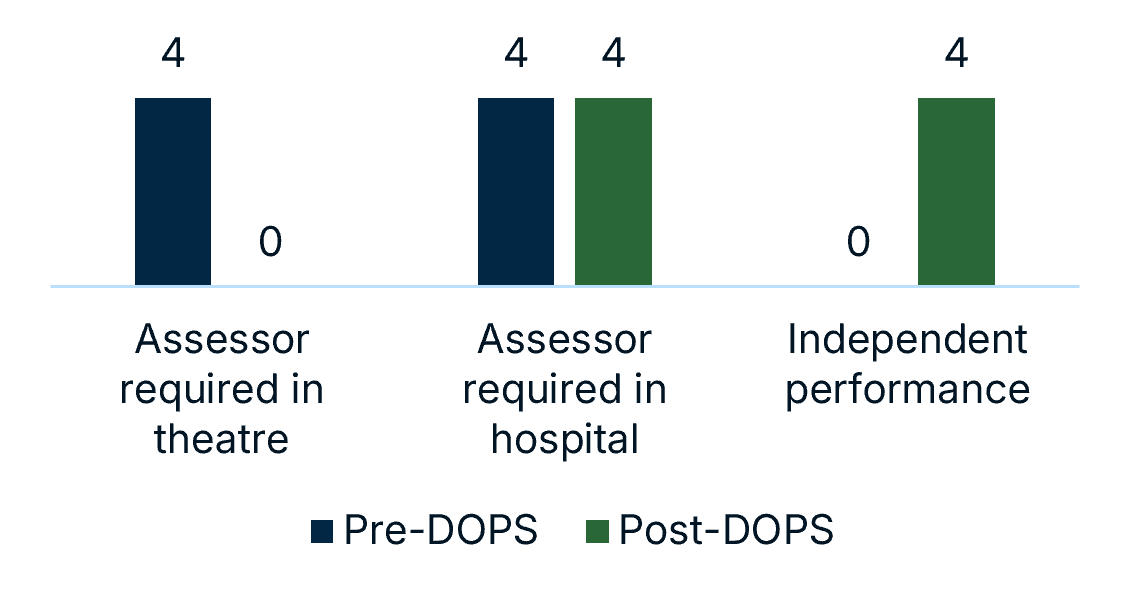
Residents requiring assessor in theatre | 50.0% → 0% |
Residents achieving independent performance | 0% → 50.0% |
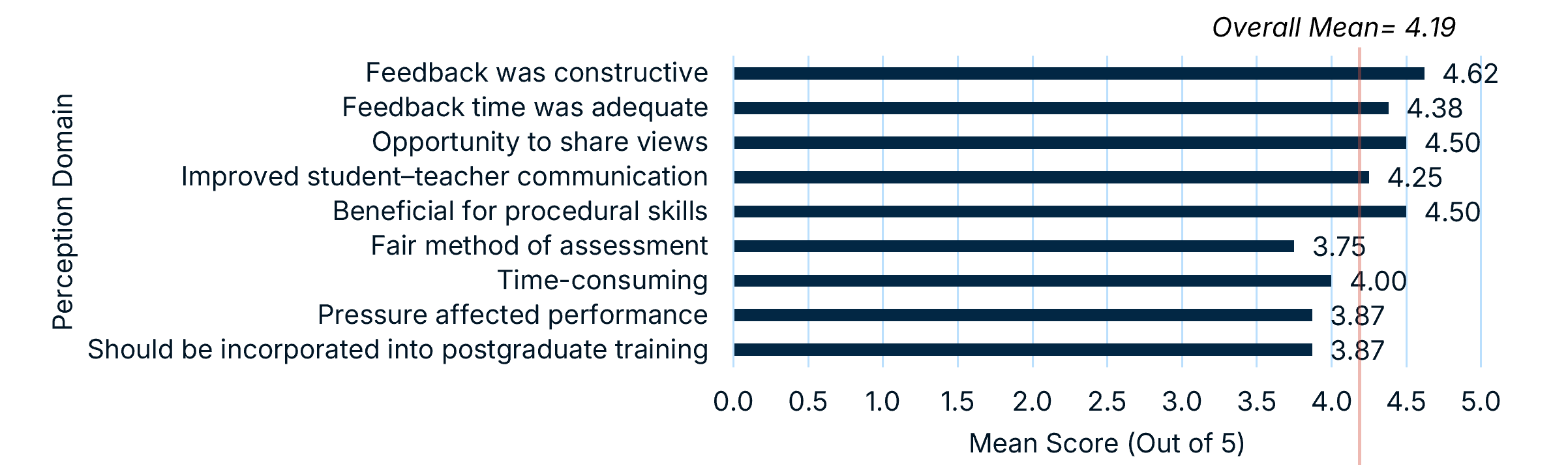
Overall resident perception score | 4.19/5 |
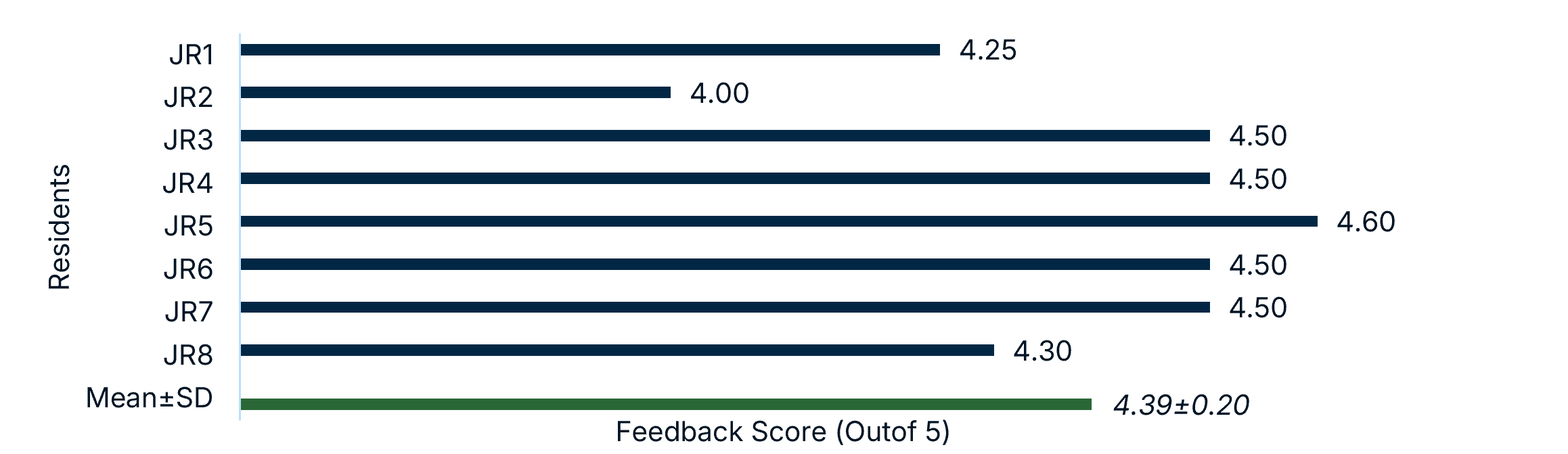
Overall post-DOPS feedback score | 4.39±0.20 |
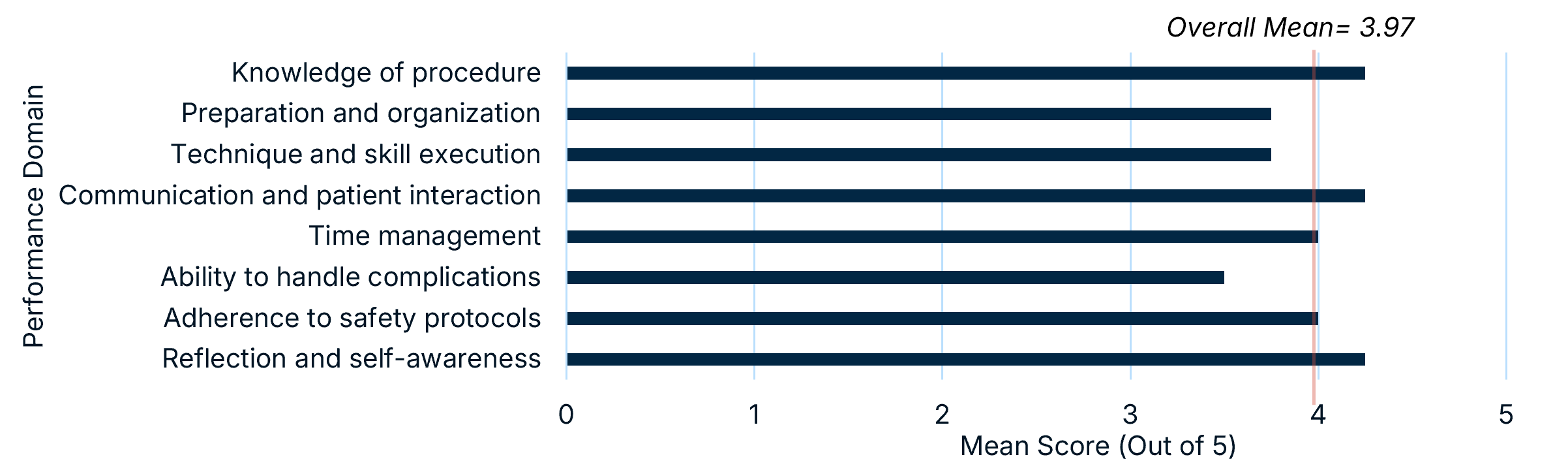
Overall faculty assessment score | 3.97/5 |
Highest resident perception score | Constructive feedback: 4.62/5 |
Lowest faculty-rated domain | Ability to handle complications: 3.50/5 |
Major qualitative benefits | Enhanced confidence; improved faculty–resident communication |
Major implementation challenges | Time constraints; assessor variability |
Discussion
The present study demonstrated significant improvement in procedural performance following implementation of DOPS among anaesthesia residents. The observed mean improvement of 2.50 points in DOPS scores suggests enhanced assessor-rated procedural performance following implementation. This improvement may be attributed to structured formative feedback, repeated procedural practice, increased familiarity with assessment criteria, and greater awareness of expected performance standards. The assessment process itself may also have influenced residents' performance by encouraging more focused preparation and attention to procedural steps. However, because the study lacked a control group, the relative contribution of DOPS feedback cannot be distinguished from routine clinical exposure, repeated practice, or assessment familiarity. Although statistically significant, the clinical and educational relevance of the 2.50-point improvement in DOPS scores remains uncertain without a validated minimum important difference. Improved scores do not necessarily indicate sustained competence, independent performance, or enhanced patient safety. The lowest faculty rating for complication management (3.50/5) highlights the need for supervised practice, simulation-based training, and targeted feedback. Assessor variability may affect assessment reliability and validity despite standardized checklists and faculty calibration. As inter-rater reliability was not evaluated, future studies should incorporate multiple trained assessors, standardized scoring, and formal reliability testing. Similar improvement has been reported by Kamat et al.[8] among 55 anaesthesiology postgraduate students, where performance improved significantly following DOPS assessment, feedback, demonstration, and reassessment. Dabir et al.[9] also reported improvement in clinical procedural skills following repeated DOPS assessments among anaesthesiology residents. These findings suggest that repeated direct observation combined with structured feedback can contribute to improvement in procedural performance.
The present study also demonstrated progression toward procedural independence. Before implementation, 50% of residents required the assessor to remain in the operating theatre and none performed independently. Following DOPS, no resident required continuous assessor presence in the theatre and 50% achieved independent performance. Erfani Khanghahi and Ebadi Fard Azar[6], in a systematic review of 28 studies, similarly identified improvement in practical skills and promotion of independence as important strengths of DOPS.
Comparable improvement has also been observed in other postgraduate specialties. In a study of 20 urology residents, passing performance improved from 35% to 85% for cystoscopy, from 30% to 70% for transurethral resection of the prostate, and from 15% to 70% for ureterorenoscopy following DOPS-based training and reassessment.[10] Similarly, Kumar et al.[11] demonstrated significant improvement between the first and sixth DOPS encounters among postgraduate obstetrics and gynaecology trainees, with improvement in both procedural skills and confidence.
Residents in the present study showed favourable perceptions toward DOPS, with an overall perception score of 4.19/5. Constructive feedback received the highest score of 4.62/5, while perceived improvement in procedural skills and opportunity to express views both scored 4.50/5. Lagoo and Joshi[7], in a study involving 12 anaesthesiology postgraduate students and 10 faculty members, also reported favourable perceptions regarding DOPS and highlighted its usefulness in identifying performance gaps, providing feedback, and facilitating trainee–faculty interaction.
Similar acceptance was reported by Singh et al.[12] among dental students, where the overall satisfaction and acceptance score was also 4.19/5. Participants rated the usefulness of DOPS for improving skill learning at 4.01/5, and 83% wanted DOPS to be extended to other clinical areas. The similarity between their overall acceptance score and the 4.19/5 observed in the present study further supports the acceptability of DOPS as a formative assessment method.
The overall post-DOPS feedback score in the present study was 4.39±0.20 indicating favourable acceptance of the feedback process. This is consistent with the systematic review by Erfani Khanghahi and Ebadi Fard Azar[6], which identified structured feedback as one of the principal strengths of DOPS. Dabir et al.[9] also reported increased resident satisfaction following repeated DOPS encounters.
Faculty assessment in the present study yielded an overall score of 3.97/5. Knowledge, communication and patient interaction, and reflection and self-awareness received the highest ratings of 4.25/5 each, whereas ability to handle complications received the lowest score of 3.50/5. These findings demonstrate the usefulness of DOPS in identifying specific areas of strength and areas requiring further supervision rather than providing only a global assessment of procedural competence.
Time requirement was an important concern in the present study. Residents rated DOPS as time-consuming at 4.00/5, and time constraints also emerged during the qualitative assessment. Similar findings have been reported in paediatric postgraduate training. In a study involving 15 postgraduate trainees, 80 procedures and nine faculty assessors, seven of nine assessors considered DOPS feasible and nonintrusive, although five of nine considered it time-consuming.[13] Kamat et al.[8] reported an average assessment duration of approximately 11 minutes and an average feedback duration of approximately 13 minutes, indicating that DOPS is feasible but requires dedicated faculty time.
Enhanced confidence and improved faculty–resident communication were important qualitative findings in the present study. These findings are consistent with the repeated-DOPS study by Kumar et al.[11], which demonstrated improvement in confidence along with procedural skills, and with Lagoo and Joshi[7], who reported favourable perceptions regarding trainee–faculty interaction.
Assessor variability was another challenge identified in the present study. Chuan et al.[14] evaluated DOPS for ultrasound-guided regional anaesthesia and reported inter-rater reliability coefficients ranging from −0.01 to 0.43 for individual DOPS items and 0.15 for overall performance. Their findings indicate that differences between assessors can influence DOPS ratings and emphasize the need for faculty orientation and assessor calibration.
Overall, the present findings were consistent with previous studies demonstrating improvement in procedural performance, increased confidence, favourable learner perceptions, and the educational value of structured feedback following DOPS.[6-13] At the same time, time constraints and assessor variability remain important challenges.[6,13,14] DOPS may therefore be useful as a formative workplace-based assessment method in postgraduate anaesthesiology when implemented through repeated observations, timely feedback, standardized assessment criteria, and appropriately trained faculty.
The mean improvement of 2.50 points on the nine-point DOPS scale indicates improved assessor-rated procedural performance. However, its educational significance remains uncertain, as a validated minimum important difference was not established. Repeated practice, clinical exposure, structured feedback, and assessment familiarity may have contributed to this improvement. Management of complications received the lowest faculty rating (3.50/5), highlighting the need for targeted training through supervised practice, simulation, and formative feedback. Assessor variability may also affect assessment reliability, emphasizing the importance of standardized criteria, faculty calibration, and repeated assessments by multiple assessors.
The findings have practical implications for integrating DOPS into competency-based postgraduate medical education. DOPS can be incorporated into routine clinical postings as a structured workplace-based formative assessment method, allowing faculty members to directly observe procedural performance, provide specific feedback, and document areas requiring improvement. Repeated assessments across different procedures, assessors, and clinical contexts may help generate a more comprehensive picture of trainee progression. Faculty development in observation, feedback, and assessment calibration is essential for consistent implementation. DOPS should complement other workplace-based assessment methods and longitudinal clinical supervision rather than serve as the sole basis for decisions regarding procedural independence.
Limitations
The small convenience sample, absence of an a priori sample size calculation, and assessment of different procedures across training years limit the precision, comparability, and generalizability of the findings. The pooled analysis may not fully account for differences in procedural difficulty and previous clinical experience. The intervention period of four months was relatively short and did not permit assessment of long-term retention of procedural competence. Only selected procedures were assessed according to the residents' year of training. Inter-rater reliability was not formally assessed. Although faculty members were oriented to the DOPS process, potential variation in assessor interpretation and scoring may have influenced the observed changes. The absence of a control group also prevents separation of the effects of structured feedback from repeated practice, increasing clinical experience, and familiarity with the assessment process. In addition, repeated exposure to the same assessment process may itself have contributed to improvement in subsequent scores.
Conclusion
DOPS implementation was associated with improved procedural assessment scores and progression toward greater procedural independence among participating anaesthesia residents. Structured direct observation and formative feedback may be valuable components of postgraduate procedural training. However, larger multicentre controlled studies with standardized assessment tools, assessor calibration, and longer follow-up are needed to establish the effectiveness and sustainability of this approach.
Declarations
Conflicts of Interest: None declared.
Funding: No external funding received.
AI usage declaration: Generative AI was used for improvement of language and readability. It was not used to generate or alter participant data, observations or findings. The authors reviewed the final text and remain responsible for the accuracy of all data, references and methodological statements.
References
- Miller GE. The assessment of clinical skills/competence/performance. Acad Med. 1990;65(9 Suppl):S63-S67. doi:10.1097/00001888-199009000-00045
- Norcini J, Burch V. Workplace-based assessment as an educational tool: AMEE Guide No. 31. Med Teach. 2007;29(9):855-871. doi:10.1080/01421590701775453
- Wilkinson JR, Crossley JGM, Wragg A, Mills P, Cowan G, Wade W. Implementing workplace-based assessment across the medical specialties in the United Kingdom. Med Educ. 2008;42(4):364-373. doi:10.1111/j.1365-2923.2008.03010.x
- Norcini J, Anderson B, Bollela V, Burch V, Costa MJ, Duvivier R, et al. Criteria for good assessment: Consensus statement and recommendations from the Ottawa 2010 Conference. Med Teach. 2011;33(3):206-214. doi:10.3109/0142159X.2011.551559
- Bindal T, Wall D, Goodyear HM. Trainee doctors' views on workplace-based assessments: Are they just a tick box exercise? Med Teach. 2011;33(11):919-927. doi:10.3109/0142159X.2011.558140
- Erfani Khanghahi M, Ebadi Fard Azar F. Direct observation of procedural skills (DOPS) evaluation method: Systematic review of evidence. Med J Islam Repub Iran. 2018;32:45. doi:10.14196/mjiri.32.45
- Lagoo JY, Joshi SB. Introduction of direct observation of procedural skills (DOPS) as a formative assessment tool during postgraduate training in anaesthesiology: Exploration of perceptions. Indian J Anaesth. 2021;65(3):202-209. doi:10.4103/ija.IJA_124_20
- Kamat C, Todakar M, Patil M, Teli A. Changing trends in assessment: Effectiveness of Direct observation of procedural skills (DOPS) as an assessment tool in anaesthesiology postgraduate students. J Anaesthesiol Clin Pharmacol. 2022;38(2):275-280. doi:10.4103/joacp.JOACP_329_20
- Dabir S, Hoseinzadeh M, Mosaffa F, Hosseini B, Dahi M, Vosoughian M, et al. The effect of repeated direct observation of procedural skills (R-DOPS) assessment method on the clinical skills of anaesthesiology residents. Anesth Pain Med. 2021;11(1):e111074. doi:10.5812/aapm.111074
- Ali L, Ali S, Orakzai N, Ali N. Effectiveness of direct observation of procedural skills (DOPS) in postgraduate training in urology at institute of kidney diseases, Peshawar. J Coll Physicians Surg Pak. 2019 Jun 1;29(6):516-9. doi:10.29271/jcpsp.2019.06.516
- Kumar N, Singh NK, Rudra S, Pathak S. Effect of formative evaluation using direct observation of procedural skills in assessment of postgraduate students of obstetrics and gynecology: Prospective study. J Adv Med Educ Prof. 2017;5(1):1-5.
- Singh G, Kaur R, Mahajan A, Thomas AM, Singh T. Piloting direct observation of procedural skills in dental education in India. Int J Appl Basic Med Res. 2017;7(4):239-242. doi:10.4103/ijabmr.IJABMR_54_17
- Goel A, Singh T. Feasibility and acceptability of direct observation of procedural skills to improve procedural skills. Indian Pediatr. 2014;51(1):59-60. doi:10.1007/s13312-014-0327-x
- Chuan A, Thillainathan S, Graham PL, Jolly B, Wong DM, Smith N, et al. Reliability of the Direct Observation of Procedural Skills assessment tool for ultrasound-guided regional anaesthesia. Anaesth Intensive Care. 2016;44(2):201-209. doi:10.1177/0310057X1604400206